In the overview
I set up a sweep of AllReduce / AllGather across a switch and a 2-D torus,
holding per-link physics identical. Here’s the first result: every collective
lives in one of two regimes, and the message size decides which.
The two regimes, and where torus separates from switch
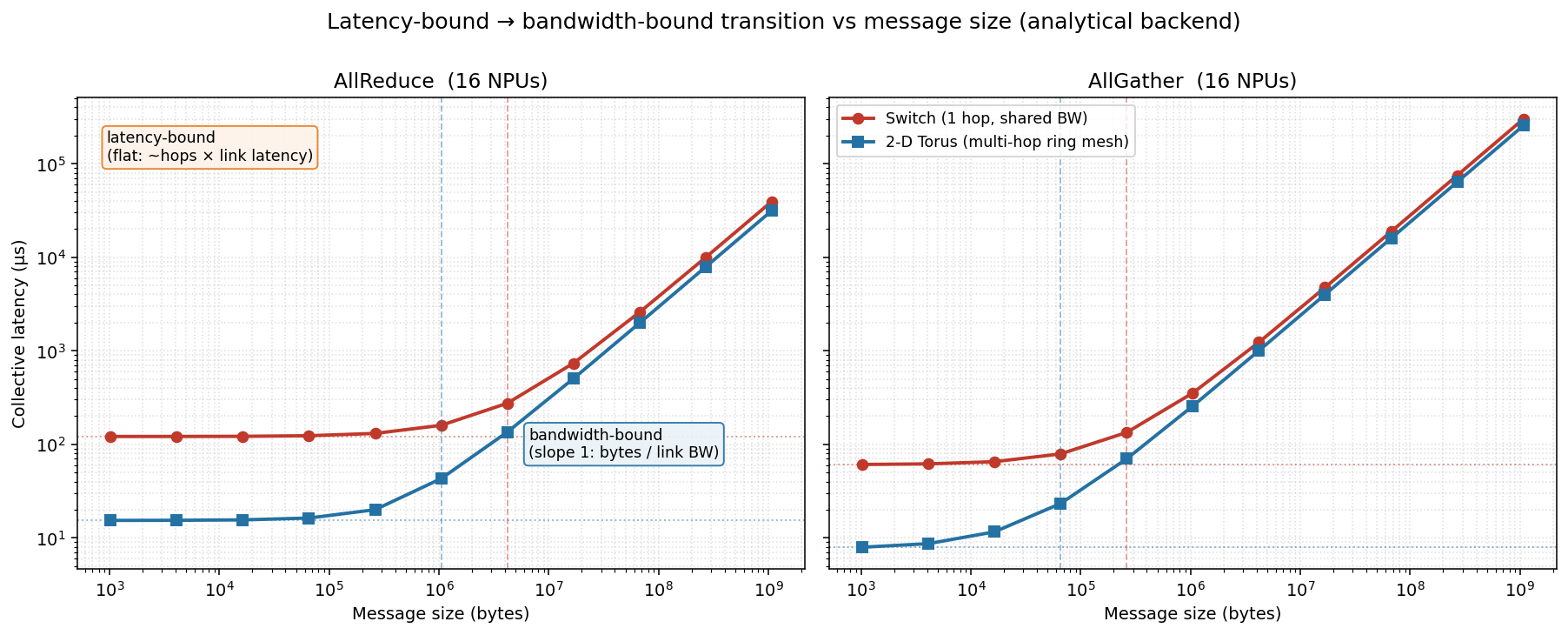
Read each curve left to right. On the left, latency is flat — doubling a tiny message barely moves it, because time is dominated by the fixed per-step link latency, not the payload. This is the latency-bound regime. On the right, every curve becomes a straight slope-1 line on log-log axes: latency is now proportional to bytes, i.e. bandwidth-bound.
The two topologies sit on top of each other while latency-bound (same number of algorithm steps), then the torus pulls clearly below the switch as messages grow — its 2 links/node give more aggregate bandwidth than the switch’s shared fabric. At 16 NPUs, AllReduce crosses from latency- to bandwidth-bound around ~1 MB on the torus but only around ~4 MB on the switch: the switch’s higher latency floor keeps it latency-bound longer.
The same data as effective bandwidth
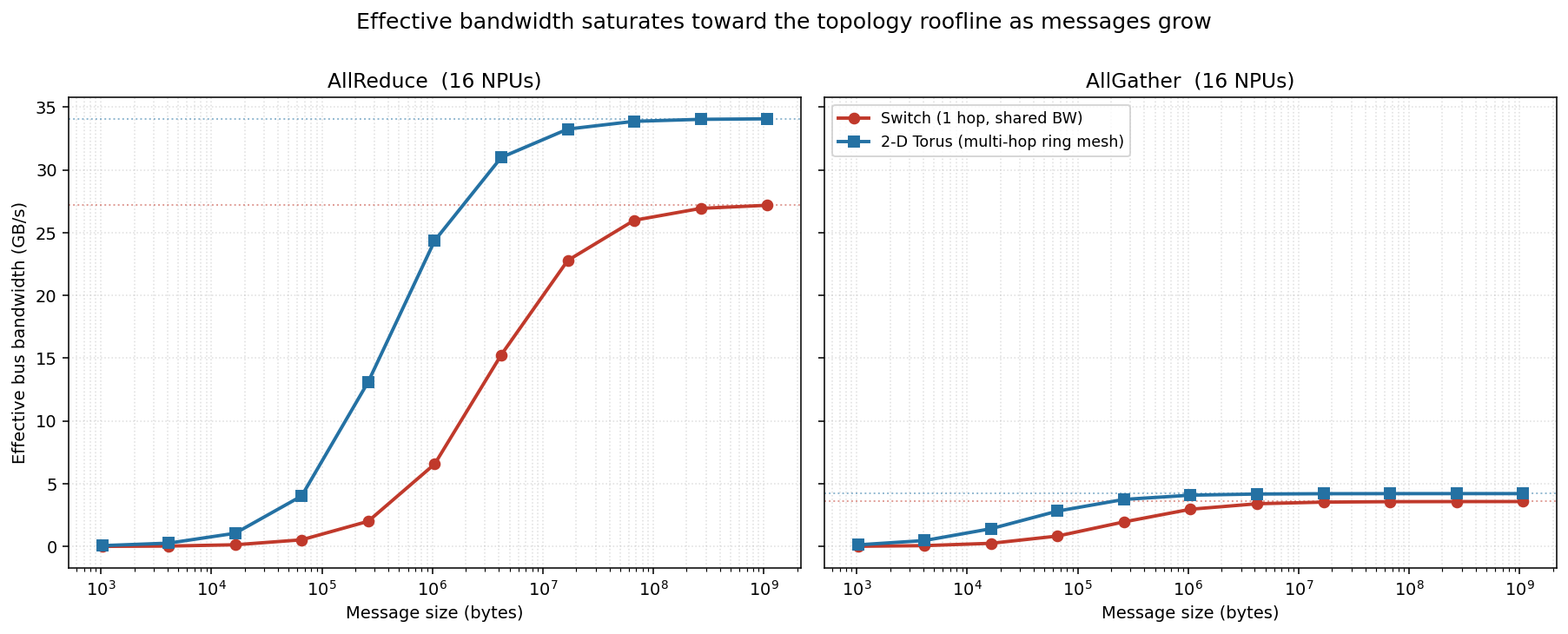
Plotting delivered bandwidth (bytes ÷ time) makes the transition tangible. Small messages waste the fabric — almost all the time is latency, so effective bandwidth is near zero. As messages grow, each curve climbs and saturates toward a topology-dependent roofline. The torus’s roofline is higher; the switch saturates lower. The knee of this curve is the latency→bandwidth crossover from the first figure.
The practical reading: there is a minimum message size below which you simply cannot use your fabric efficiently, and that threshold is higher on the switch. If your collectives are smaller than the knee, you’re paying for latency and buying more bandwidth won’t help.
Next: what happens as you scale the node count — where the two regimes diverge most, and a single picture of when topology actually matters.